Environment & Context

Environmental Impact on Well-being

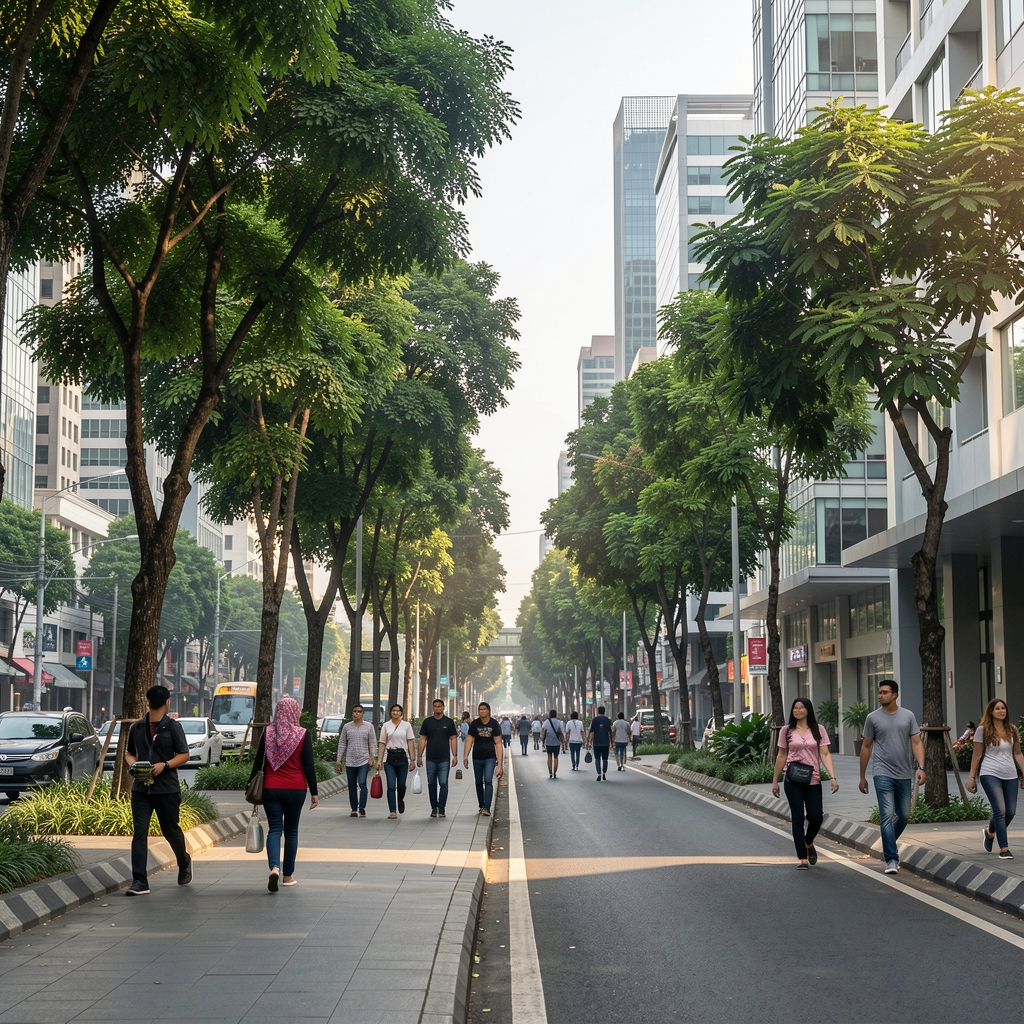
Aerial view of a dense green urban park surrounded by city buildings in Jakarta, midday light filtering through tree canopies, contrast between nature and urban infrastructure

The Environment as a Background Variable

When discussions of well-being focus on what an individual eats or how much they exercise, the surrounding environment is often treated as a fixed backdrop rather than an active variable. Yet research across epidemiology, circadian biology and environmental science consistently identifies the physical context in which daily life takes place as a meaningful contributor to how the body functions — not through dramatic single-event exposures, but through the accumulated effect of ongoing conditions.

For men living in urban Indonesia — particularly in major cities like Jakarta, Surabaya or Medan — the environmental profile includes a specific set of factors: equatorial heat and humidity, urban air quality, dense traffic noise, intense artificial lighting at night and limited access to natural green space. These conditions shape sleep patterns, appetite regulation, physical activity and psychological state in ways that are documented in the literature but rarely integrated into popular discussions of male well-being.

Air Quality and Respiratory Context

Particulate matter (PM2.5 and PM10), ground-level ozone and nitrogen oxides are the primary air quality concerns in Indonesian urban centres. Jakarta has consistently ranked among cities with elevated particulate levels, driven by vehicle emissions, industrial activity and seasonal factors including biomass burning in surrounding regions.

The physiological effects of chronic exposure to elevated particulate matter include changes in respiratory efficiency, inflammatory markers and cardiovascular load. Research published in environmental health journals indicates that these effects are not limited to acute high-exposure events but accumulate over time with moderate chronic exposure. For men who spend significant portions of their day in outdoor or semi-outdoor environments — including commuting, construction and informal sector work — ambient air quality represents a genuine background condition rather than an occasional concern.

It is worth noting that air quality in Indonesian cities is highly variable by district, season and time of day. Areas closer to industrial corridors or major arterial roads consistently record higher readings than residential or green-space-adjacent areas, and readings during dry-season months (July–September) typically exceed those in the wet season.

PM2.5
Primary urban particulate measure in Southeast Asian cities
Jul–Sep
Peak particulate season in Java, driven by dry conditions and biomass burning
5–8 hrs
Typical daily outdoor exposure range for urban commuters in Indonesian cities

Light Exposure and Circadian Patterns

The human body's circadian system — the internal timekeeping mechanism that coordinates sleep, hormone secretion, digestion and energy metabolism — is primarily synchronised by light. Specifically, the timing and intensity of light reaching the retina in the morning and evening sends signals that anchor the body's internal clock to the external day-night cycle.

In equatorial Indonesia, daylight hours remain relatively consistent throughout the year, roughly 12 hours of daylight and 12 of darkness. This consistency, compared to regions with pronounced seasonal variation, means the circadian challenge is less about seasonal light shifts and more about the disruption caused by artificial lighting at night and insufficient morning outdoor exposure.

Urban environments introduce significant amounts of artificial light after sunset — from screens, street lighting, shop fronts and advertising. Research in chronobiology indicates that blue-spectrum light in the evening hours delays the natural rise of melatonin, which is associated with the initiation of sleep. For men who work long hours and spend evenings under artificial light or with screens, this can shift the sleep window later, reducing overall sleep duration when morning commitments remain fixed. The downstream effects on appetite regulation, energy and cognitive performance are documented in sleep research literature, though the magnitude varies significantly between individuals.

~12 hrs
Consistent daylight duration year-round near the equator
Blue light
Short-wavelength spectrum that most affects circadian signalling via the retina
30–60 min
Morning outdoor light exposure duration associated with stronger circadian anchoring in studies

Urban Noise and the Nervous System

Noise is among the most pervasive environmental exposures in densely populated urban areas, yet it receives comparatively little attention in everyday discussions of well-being. The World Health Organization has classified environmental noise as a significant public health concern, with research linking chronic exposure to elevated noise levels (above approximately 65 dB averaged over a day) to sleep disruption, elevated psychological stress indicators and cardiovascular changes over time.

In Jakarta and other Indonesian metropolitan areas, traffic noise is the dominant source — particularly in areas adjacent to toll roads, bus corridors and markets. Noise levels during morning and evening peak hours on major urban arteries routinely exceed 70–80 dB, a range associated with sustained auditory fatigue. For residents in areas with dense traffic proximity, this represents a chronic condition rather than an acute event.

The mechanism through which noise affects the body is partly auditory and partly autonomic: the nervous system responds to sound as a potential signal requiring attention, even during sleep. This results in elevated activation in the autonomic nervous system, which over time can affect sleep architecture and physiological recovery even when the individual does not consciously perceive waking from noise events.

65 dB
WHO threshold above which chronic daily exposure is associated with documented physiological changes
70–80 dB
Typical peak-hour traffic noise range on major Jakarta arterial roads
Autonomic
The nervous system pathway through which noise most consistently affects sleep quality at moderate exposure levels

Green Space Access and Its Documented Associations

A growing body of urban health research has examined the relationship between proximity to green space — parks, tree-lined streets, waterways and natural areas — and a range of well-being indicators. Studies conducted in both high-income and middle-income urban settings suggest associations between greater green space access and lower stress marker levels, higher rates of physical activity and more favourable self-reported mental states, though the direction of causality is difficult to establish given that higher-income neighbourhoods tend to have both more green space and other well-being advantages.

Within the Indonesian urban context, green space access is highly uneven. Jakarta's urban planning history has resulted in significant variation between neighbourhoods, with formal residential areas and newer developments often providing more park access than high-density informal settlements. The relevance for well-being research is that environmental factors operate at the neighbourhood level, not merely at the individual level — meaning that individual choices about diet or activity take place within a structural context that either facilitates or constrains them.

Heat, Humidity and Physical Exertion Patterns

Indonesia's equatorial climate means that outdoor temperature and humidity levels are a persistent physiological consideration throughout the year. Average temperatures in Jakarta range between 26°C and 32°C, with relative humidity typically between 70% and 90%. Under these conditions, thermoregulation during physical exertion requires more active sweating than in cooler, drier environments, which affects fluid and electrolyte balance during and after physical activity.

This climate context has implications for how physical activity patterns among Indonesian men are structured. Research on physical activity in tropical climates suggests that outdoor exertion tends to shift toward cooler parts of the day — early morning or after sunset — and that heat-adapted populations maintain activity levels through adaptation of timing rather than reduction of intensity. The fluid balance demands of activity in hot, humid conditions are higher than standard guidelines (developed largely in temperate-climate research contexts) typically reflect.

Integrating Environmental Context into Understanding

The factors described in this article — air quality, light patterns, noise exposure, green space access and climate — do not operate independently. They form an interconnected environmental profile that shapes the physiological and psychological baseline from which any individual navigates daily life. Understanding well-being in this context requires treating the environment not as a neutral container but as an active participant in the body's daily regulation.

This does not mean that individual choices are irrelevant — they clearly are not. It does mean that frameworks for understanding male well-being that focus entirely on individual behaviour and nutrition while ignoring the structural and environmental context in which that behaviour takes place offer a partial and potentially misleading picture.